Close


Advanced Search

Close
Find your sunscreen
Filter your search

Limit Results

Sort results


EWG's Guide to Sunscreens™

2026’s Top-Rated Sunscreens EWG Research FAQs About the Guide
DONATE

HOME / recreational sunscreens / beach & sport sunscreen


Score

Hampton Sun Mineral Sunscreen Spray, SPF 30

Hampton Sun Mineral Sunscreen Spray, SPF 30

WHERE TO BUY

When you make a purchase through retailer links on our site, we may earn commission through affiliate programs. All affiliate fees EWG receives support our nonprofit mission. Learn more here

CATEGORY

recreational sunscreens

BRAND

Hampton Sun

DATA LAST UPDATED

November 05, 2026

Health Concerns

  • MODERATE
    Cancer
  • HIGH
    Allergies & Immunotoxicity
  • LOW
    Developmental and Reproductive Toxicity
  • HIGH
    Use Restrictions

Efficacy Concerns

  • Caution We have flagged this product with 3 concerns
    Expand content Collapse content

    Find better scoring products

    Mineral sunscreen sprays may contain small particles which can damage lungs if inhaled. Read more

    Sunscreens can break down while still in the bottle. To be safe, dispose of products when the mixture clumps or separates.

  • moderate
    UVA/UVB Balance

Ingredient Scores

Ingredients are scored based on their formulation and concentration in this product. Click on an ingredient for more information.

Zinc Oxide(Sunscreen Grade) active ingredient 7.2%
Data Availability: Good
Expand content Collapse content
CONCERNS Cancer (low), Developmental/reproductive toxicity (low), Allergies/immunotoxicity (moderate), Use restrictions (moderate), Persistence and bioaccumulation (low), Non-reproductive organ system toxicity (low), Ecotoxicology (low), Occupational hazards (moderate), Biochemical or cellular level changes (high)
LEARN MORE ABOUT THIS INGREDIENT
TITANIUM DIOXIDE (sunscreen grade) active ingredient 4%
Data Availability: Good
Expand content Collapse content
CONCERNS Cancer (moderate), Developmental/reproductive toxicity (low), Allergies/immunotoxicity (low), Enhanced skin absorption, Use restrictions (moderate), Non-reproductive organ system toxicity (moderate), Irritation (skin, eyes, or lungs) (low), Occupational hazards (high), Biochemical or cellular level changes (high)
LEARN MORE ABOUT THIS INGREDIENT
ALOE BARBADENSIS (ALOE VERA) LEAF JUICE
Data Availability: Good
Expand content Collapse content
CONCERNS Use restrictions (low)
LEARN MORE ABOUT THIS INGREDIENT
CAPRYLIC/CAPRIC TRIGLYCERIDE
Data Availability: Limited
Expand content Collapse content
CAPRYLYL GLYCOL
Data Availability: Limited
Expand content Collapse content
CETYL DIGLYCERYL TRIS(TRIMETHYLSILOXY)SILYLETHYL DIMETHICONE
Data Availability: None
Expand content Collapse content
CONCERNS Contamination concerns (CYCLOPENTASILOXANE and CYCLOTETRASILOXANE)
LEARN MORE ABOUT THIS INGREDIENT
ETHYLHEXYLGLYCERIN
Data Availability: Limited
Expand content Collapse content
CONCERNS Allergies/immunotoxicity (low), Non-reproductive organ system toxicity (moderate), Ecotoxicology (low), Irritation (skin, eyes, or lungs) (high)
LEARN MORE ABOUT THIS INGREDIENT
FRAGRANCE
Data Availability: Fair
Expand content Collapse content
CONCERNS Allergies/immunotoxicity (high), Endocrine disruption (moderate), Non-reproductive organ system toxicity (moderate), Ecotoxicology (low), Irritation (skin, eyes, or lungs) (moderate)
LEARN MORE ABOUT THIS INGREDIENT
GLYCERIN
Data Availability: Fair
Expand content Collapse content
CONCERNS Use restrictions (moderate)
LEARN MORE ABOUT THIS INGREDIENT
HYDROGENATED POLYDECENE
Data Availability: Fair
Expand content Collapse content
CONCERNS Persistence and bioaccumulation (moderate), Non-reproductive organ system toxicity (moderate)
LEARN MORE ABOUT THIS INGREDIENT
ISOPROPYL MYRISTATE
Data Availability: Fair
Expand content Collapse content
CONCERNS Allergies/immunotoxicity (low), Enhanced skin absorption, Irritation (skin, eyes, or lungs) (moderate)
LEARN MORE ABOUT THIS INGREDIENT
JOJOBA ESTERS
Data Availability: Limited
Expand content Collapse content
PENTYLENE GLYCOL
Data Availability: Limited
Expand content Collapse content
CONCERNS Cancer (low), Developmental/reproductive toxicity (low), Allergies/immunotoxicity (low), Enhanced skin absorption, Non-reproductive organ system toxicity (low), Irritation (skin, eyes, or lungs) (low)
LEARN MORE ABOUT THIS INGREDIENT
POLYHYDROXYSTEARIC ACID
Data Availability: Fair
Expand content Collapse content
CONCERNS Irritation (skin, eyes, or lungs) (low)
LEARN MORE ABOUT THIS INGREDIENT
PROPANEDIOL
Data Availability: Fair
Expand content Collapse content
CONCERNS Cancer (low), Developmental/reproductive toxicity (low), Enhanced skin absorption, Endocrine disruption (low), Irritation (skin, eyes, or lungs) (high)
LEARN MORE ABOUT THIS INGREDIENT
SILICA, AMORPHOUS
Data Availability: Good
Expand content Collapse content
CONCERNS Cancer (moderate), Developmental/reproductive toxicity (low), Use restrictions (low), Persistence and bioaccumulation (high), Irritation (skin, eyes, or lungs) (low)
LEARN MORE ABOUT THIS INGREDIENT
SODIUM CHLORIDE
Data Availability: Robust
Expand content Collapse content
SODIUM HYALURONATE active ingredient 1%
Data Availability: Fair
Expand content Collapse content
SODIUM PHYTATE
Data Availability: Limited
Expand content Collapse content
CONCERNS Cancer (low), Developmental/reproductive toxicity (low), Non-reproductive organ system toxicity (low), Irritation (skin, eyes, or lungs) (low)
LEARN MORE ABOUT THIS INGREDIENT
SORBITAN OLIVATE
Data Availability: Limited
Expand content Collapse content
CONCERNS Cancer (low), Developmental/reproductive toxicity (low), Non-reproductive organ system toxicity (low), Irritation (skin, eyes, or lungs) (low)
LEARN MORE ABOUT THIS INGREDIENT
STEARIC ACID
Data Availability: Good
Expand content Collapse content
CONCERNS Cancer (low), Developmental/reproductive toxicity (low), Allergies/immunotoxicity (low), Multiple, additive exposure sources (low), Irritation (skin, eyes, or lungs) (low)
LEARN MORE ABOUT THIS INGREDIENT
SYNTHETIC BEESWAX
Data Availability: Limited
Expand content Collapse content
CONCERNS Contamination concerns (Polycyclic Aromatic Hydrocarbons (PAHs))
LEARN MORE ABOUT THIS INGREDIENT
TOCOPHERYL ACETATE
Data Availability: Limited
Expand content Collapse content
CONCERNS Cancer (low), Developmental/reproductive toxicity (low), Allergies/immunotoxicity (moderate), Contamination concerns (HYDROQUINONE)
LEARN MORE ABOUT THIS INGREDIENT
WATER
Data Availability: Robust
Expand content Collapse content

Ingredients from label

active ingredients: zinc oxide 7.2%, titanium dioxide 4.0%, inactive ingredients: aloe barbadensis leaf juice, caprylic/capric triglyceride, caprylyl glycol, cetyl diglyceryl tris(trimethylsiloxy)silylethyl, dimethicone, ethylhexylglycerin, fragrance, glycerin, hydrogenated polydecene, isopropyl myristate, jojoba esters, pentylene glycol, polyhydroxystearic acid, propanediol, silica, sodium chloride, sodium hyaluronate 1% solution, sodium phytate, sorbitan olivate, stearic acid, synthetic beeswax, tocopheryl acetate, water.



Understanding scores

Not all sunscreen products are the same when it comes to sun protection and ingredient health hazards. The scoring system for EWG’s Guide to Sunscreens is designed to help the public find products that are safer, avoid ingredients of concern, and are more effective in reducing potential health harms from ultraviolet A and B exposure.

Every product in the guide gets a hazard and efficacy rating. The top scoring products have both a low hazard rating and an excellent UVA/UVB balance rating.

HOW WE DETERMINE SCORES

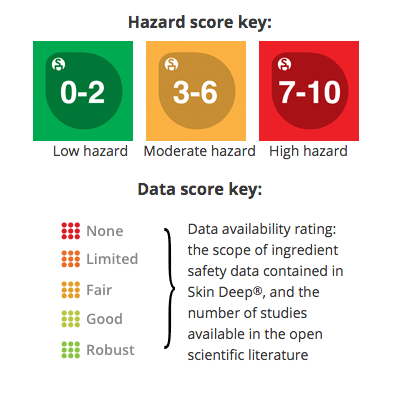
Hazard score

The hazard score, from 1 to 10, reflects known and suspected hazards linked to the ingredients. Beyond this 1 to 10 ranking, the EWG Verified® mark on a sunscreen means a product meets EWG’s strictest criteria for transparency and health.

Scoring legend

EWG Verified® process

EWG Verified logo
EWG Verified

Beyond the hazard score, the EWG Verified mark on a sunscreen indicates that a product has met our strictest standards for efficacy, ingredient safety and transparency.


TIPS

Sunscreen alone
is not enough

VIEW THE LIST

Wear clothes

Shirts, hats, shorts and pants shield your skin from the sun’s UV rays, reducing burn risk.

Plan around the sun

Go outdoors in early morning or late afternoon when the sun is lower in the sky.

Find shade – or make it

Picnic under a tree or take a canopy to the beach. Keep infants in the shade, reducing the risk of multiple burns by 30 percent.


Don’t get burned

Red, sore, blistered skin means you’ve gotten far too much sun.

Sunglasses are essential

Not just a fashion accessory, sunglasses protect your eyes from UV radiation.

Check UV Index

The UV Index provides important information to help you plan your outdoor activities in ways that prevent sun overexposure.


Scan. Compare. Decide with confidence.

Find safer sunscreens with the Healthy Living™ App

SCAN TO get the app