





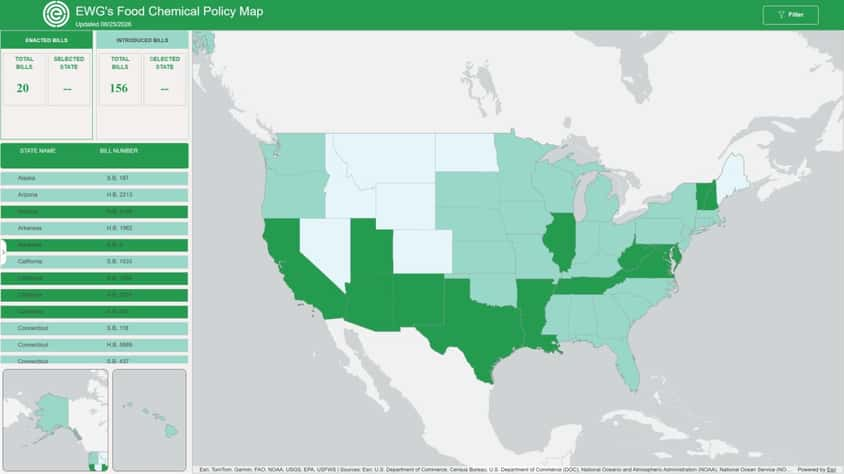
For too long, the FDA has let food chemical companies decide which food chemicals are safe to eat. So it’s good news that states are leading the way when it comes to the safety of food chemicals. But now, some members of Congress, on behalf of food and chemical industry lobbyists, are seeking to block state food chemical laws.
States with active legislation:
Illinois 
H.B. 5507 would define UPF and limit their availability in school foods.
Maryland
H.B. 1004 would ban the sale of foods containing contains brominated vegetable oil, potassium bromate, propyl paraben or Red Dye No. 3.
Massachusetts
H.B. 3959 would ban the sale of foods containing potassium bromate and propyl paraben state-wide, as well as ban public schools from distributing or selling foods that contain Blue 1, Blue 2, Green 3, Red 40, Yellow 5 or Yellow 6.
H.B. 539 would require food vendors providing public school lunches ensure that at least 50% of entrees sold and served for lunch contain healthy foods. Vendors cannot sell or serve food where more than 20% of entree items qualify as ultra-processed, or have a nutritional composition including more than 30mg of cholesterol, more than 5% of the entrees total calories come from saturated fat. Finally, each food service provider selling food items shall keep itemized nutrition data that is made publicly available.
H.D. 4705 would ban the use of Blue 1, Blue 2, Green 3, Red 3, Red 40, Yellow 5 and Yellow 6.
S.B. 1531/ H. 2496 would prohibit public schools from serving or selling foods containing harmful food dyes, including Blue 1, Blue 2, Red 3, Red 40, Yellow 5, Yellow 6, and Green 3.
Michigan
New Jersey
S.B. 4092 would immediately prohibit public schools from selling or serving food containing Red Dye No. 3, Red 40, Yellow Dye No. 5, Yellow 6, Blue Dye No. 1, Blue 2 or Green Dye No. 3. Within two years, it would ban the commercial manufacture, sale and distribution of these dyes, as well as propyl paraben and butylated hydroxyanisole.
S. 946 would prohibit public schools from selling food containing Red 3, Red 40, Blue 1, Blue 2, Green 3, Yellow 5, Yellow 6, brominated vegetable oil, titanium dioxide, propyl paraben or potassium bromate.
New York
A.B. 4008 would prohibit the sale of foods containing Red 3 or Red 40 in public schools.
A.B. 5558 would prohibit the manufacture, sale and distribution of food containing Red 3.
A.B. 6520 would require businesses to label certain foods and beverages containing harmful ingredients, including Red 3, titanium dioxide, BVO, potassium bromate and propyl paraben.
A.B. 8585 would ban the sale of products in the state intentionally containing PFAS.
A.B. 8707 would prohibit the sale of foods or beverages containing Blue 1, Blue 2, Green 3, Red 3, Red 40, Yellow 5 or Yellow 6 in public schools.
A.B. 9026 would require the testing of baby food for toxic heavy metals and the disclosure of such test results.
S. 1239/ A.B. 1556 would require disclosure of secret GRAS chemicals and ban the sale, distribution and production of food products containing potassium bromate, propyl paraben and Red 3.
S.B. 3214 would prohibit public schools from selling food containing Blue 1, Blue 2, Green 3, Red 3, Red 40, Yellow 5 or Yellow 6, unless such a sale happens off the school's premises or at least one half-hour after the end of the school day.
S.B. 6668 would prohibit public schools from serving or selling foods containing synthetic dyes such as Blue 1, Red 3 or Yellow 6.
S. 8701 would require the testing of baby food for toxic heavy metals and the disclosure of such test results.
North Carolina
H. 440 would prohibit the sale, distribution or manufacturing of food products that contain BVO, potassium bromate, propyl paraben, Blue 1, Blue 2, Green 3, Red 40, Yellow 5 or Yellow 6.
H. 874 would prohibit public schools from serving or selling foods that contain potassium bromate, propyl paraben, titanium dioxide, BVO, Blue 1, Blue 2, Green 3, Red 3, Red 40, Yellow 5 or Yellow 6.
Ohio
Pennsylvania
H.B. 1131 would prohibit public schools from serving or selling foods containing Blue 1, Blue 2, Green 3, Red 40, Yellow 5 or Yellow 6.
H.B. 1132 would define UPF and prohibit the sale or distribution of competitive foods in public schools if they are not healthy.
H.B. 1133 would require foods containing BHA to include a label that states: “WARNING: This product contains BHA, which may cause cancer."
H.B. 1134 would require foods with Blue 1, Blue 2, Green 3, Red 40, Yellow 5 or Yellow 6 to include a label that states, “This product contains synthetic colors, which may have an adverse effect on activity and attention in children.”
H.B. 507 requires the testing of baby food for heavy metals and establishes limits on heavy metal content.
S.B. 820 would require companies to disclose their "Generally Recognized as Safe" food ingredients to the public and would ban the manufacture, sale and delivery of food that contains Red Dye No. 3, Red Dye No. 40, Yellow Dye No. 5, Yellow Dye No. 6, Blue Dye No. 1, Blue Dye No. 2, Green Dye No. 3, potassium bromate, titanium dioxide, propylparaben, brominated vegetable oil, butylated hydroxyanisole, azodicarbonamide and butylated hydroxytoluene, among other additives.
South Carolina
H. 4263 would prohibit public schools from serving or selling foods containing Blue 1, Blue 2, Green 3, Red 40, Yellow 5 or Yellow 6.
H. 4339 would prohibit public schools participating in federally funded or assisted meal programs from serving or selling foods containing potassium bromate, propyl paraben, titanium dioxide, BVO, Blue 1, Blue 2, Green 3, Red 3, Red 40, Yellow 5 or Yellow 6.
S. 589 would prohibit public schools from serving or selling foods containing potassium bromate, titanium dioxide, BVO, Blue 1, Blue 2, Green 3, Red 3, Red 40, Yellow 5 or Yellow 6. The bill would also submit a request to deny Supplemental Nutrition Assistance Program, or SNAP, coverage for candy and soda.
Tennessee
H.B. 1853 would expand on H.B. 0134 to ban the sale of food and beverages on school campuses that contain any artificial food dye.
Texas
H.B. 518 would prohibit food from being served or sold to public school students if it contains BVO, potassium bromate, propyl paraben, ADA, BHA, Red 3, Red 40, Yellow 5, Yellow 6, Blue 1, Blue 2, Green 3, titanium dioxide, citrus Red 3, Orange B, ammonia caramel or sulfite ammonia caramel.
Utah
H.B. 350 would ban the use of potassium bromate, propyl paraben, Red Dye No. 40, Yellow Dye No. 5, Yellow Dye No. 6, Blue Dye No. 1, Blue Dye No. 2 or Green Dye No. 3 in school meals.
Vermont
Lowering your exposure to harmful food chemicals
While states take action to protect us, you can lower your intake of harmful food ingredients. You can:
- Consult EWG’s Food Scores database to find products that don’t use toxic food chemicals like the ones included in these state bills. When you’re on the go, use our Healthy Living app to find products.
- Choose packaged foods that are certified organic, whenever possible. These products must meet strong standards that protect consumers from exposure to potentially harmful additives.
- When possible and affordable, limit your intake of ultra-processed foods. Many contain concerning ingredients.
First created April 4, 2024.